A battery's data sheet (or specification sheet) tells you far more than the label. It's where you find the real limits: how much current the battery can deliver, how fast it can charge, what temperatures it can work in, and what the warranty covers.
This lesson walks through the main sections of a typical data sheet. The example figures are made up for teaching, not taken from any real battery. Always read the current data sheet for your exact model.
1. Find the right data sheet
- Match the exact model number. Makers often sell several versions of a battery with similar names. A "100Ah" battery might come in standard, slim, heated or high-current versions with different limits.
- Check it's current. Makers update data sheets. Look for a date or version number, and download it from the maker's own website.
- Use the maker's data sheet, not a seller's listing. Online listings sometimes copy the wrong figures.
2. Electrical basics
| Line on the sheet | Example | What it means |
|---|---|---|
| Chemistry | LiFePO4 | The cell type. It decides the charging profile and temperature limits |
| Nominal voltage | 12.8V | The average working voltage |
| Rated capacity | 100Ah | The charge it holds, under the test conditions stated |
| Energy | 1,280Wh | Nominal voltage × capacity: 12.8 × 100 |
| Usable energy or depth of discharge | 80% | How much of the capacity the maker recommends using |
Check the test conditions. Capacity is measured at a stated discharge rate and temperature. Discharging faster or in the cold gives less. See How Batteries Work: Voltage, Capacity and Energy.
3. Charging figures
| Line on the sheet | Example | What it means |
|---|---|---|
| Charge voltage | 14.2V–14.6V | The voltage your charger should be set to, or within |
| Float voltage | 13.6V, or "not required" | The holding voltage once full. Some lithium makers say not to float |
| Max continuous charge current | 50A | The most current it can safely take while charging |
| Recommended charge current | 20A | The current the maker suggests for long life |
Your mains charger, DC-DC charger and solar controller should all be set to match these figures. Their combined charge current shouldn't exceed the maximum.
4. Discharge figures
| Line on the sheet | Example | What it means |
|---|---|---|
| Max continuous discharge current | 100A | The most current it can deliver all the time |
| Peak or surge discharge current | 200A for 5 seconds | A short burst, for motor starts. Note the time limit |
| Discharge cut-off voltage | 10V | The voltage at which the BMS switches the battery off |
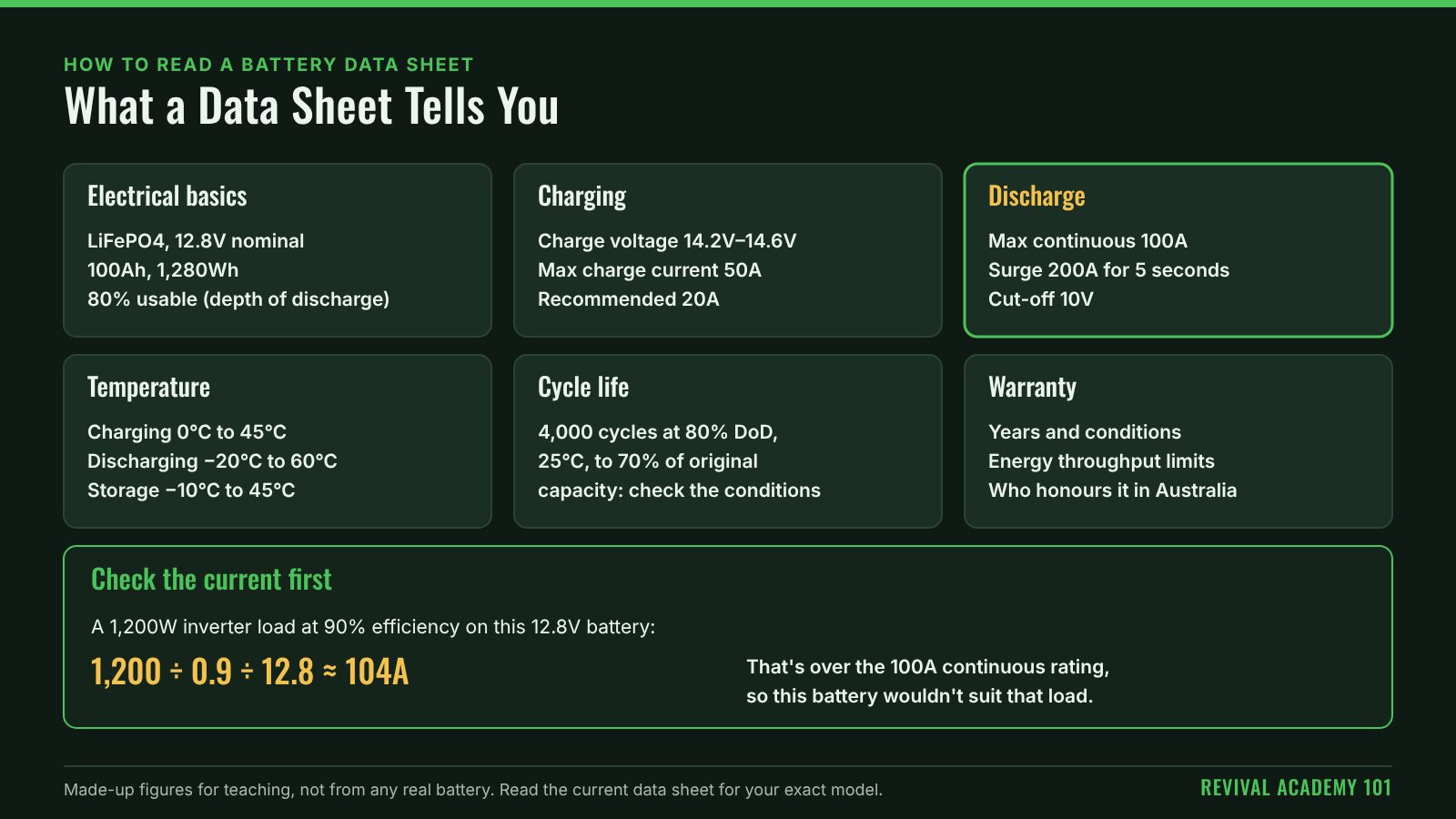
Worked example: a 1,200W inverter load on this 12.8V battery, with the inverter 90% efficient (example):
- 1,200 ÷ 0.9 ÷ 12.8 ≈ 104A
That's over the example battery's 100A continuous rating, so this battery wouldn't suit that load without a second battery or a different model. Check the current before you check anything else.
5. Temperature limits
Data sheets usually give three separate ranges:
| Range | Example |
|---|---|
| Charging | 0°C to 45°C |
| Discharging | −20°C to 60°C |
| Storage | −10°C to 45°C |
The charging range is usually the narrowest. Many LiFePO4 batteries can't be charged below about 0°C unless they have low-temperature protection or built-in heating. The data sheet says which.
6. Cycle life
| Line on the sheet | Example |
|---|---|
| Cycle life | 4,000 cycles at 80% depth of discharge, 25°C, to 70% of original capacity |
A cycle rating only means something with its conditions:
- Depth of discharge: cycles at 80% depth are harder than cycles at 50%.
- Temperature: usually tested at a mild 25°C.
- End-of-life capacity: "to 70%" means the battery is counted as worn out when it can only hold 70% of its original capacity. It still works after that, with less capacity.
You can only compare two batteries' cycle ratings when the conditions match. Read the small print, not just the headline number.
7. Physical and connection details
- Size and weight: check it fits where you plan to mount it, and that the mounting can hold the weight.
- Terminal type and torque: the maker's terminal type and tightening torque.
- Series and parallel limits: how many batteries the maker allows to be joined, if any. Some batteries don't allow series connection at all.
- Communication: some batteries talk to the inverter or charger over a data link. Check it's compatible.
- Ingress protection (IP rating): how well it resists dust and water.
8. Warranty
- Length: the years covered.
- Conditions: many warranties require a compatible charger, installation within the temperature range, or registration.
- Energy throughput or cycle limits: some warranties end after a set amount of energy has passed through the battery, even if the years aren't up.
- End-of-warranty capacity: some promise the battery will still hold a stated share of its capacity at the end of the warranty.
- Who honours it in Australia: check there's a local distributor or support.
9. Common beginner mistakes
- Reading the wrong model's data sheet, or an old version.
- Looking only at Ah, not the current limits.
- Ignoring the time limit on surge current.
- Missing the charging temperature range.
- Comparing cycle life figures with different conditions.
- Not reading the warranty conditions until something goes wrong.
10. Safety boundaries
- The data sheet's limits are the maker's safe operating limits. Don't exceed them.
- A data sheet doesn't tell you how to install the battery. Follow the installation manual. Large battery banks and anything connected to 240V AC or a home solar system need a qualified installer and, where required, a licensed electrician.
- If you can't find a data sheet for a battery at all, treat that as a warning about the battery.
11. The main lesson
Find the exact model's current data sheet. Check the current limits first, then charging, temperature, cycle conditions and warranty. Match every charger and load to it.
Continue learning
Revival Academy 101 shares practical tutorials to help you understand electrical systems and make informed decisions.
Explore related Bush & Bench projects:
- BENCH — Cordless Revival: cordless tool batteries and workshop equipment.
- BUSH — Wired For The Wild: vehicle, camping and 12V power.
- HOMESTEAD — Home & Workshop Solar: solar, battery storage and off-grid systems.
Disclosure: Some pages may contain affiliate links. Where applicable, purchases through these links may earn us a commission at no additional cost to you.
Technical note: This is general educational information, not a substitute for a design calculation, manufacturer instructions or applicable Australian standards.