Every battery label carries the same three ideas: voltage, capacity and energy. Once you understand how they fit together, you can read any battery label, from a phone power bank to a caravan battery or a home solar battery, and compare them properly.
1. What a battery does
A battery stores energy as chemical energy and releases it as electricity when a circuit is connected. Inside, it's made of one or more cells. Each cell has a positive and a negative side and makes a voltage set by its chemistry.
Charging pushes energy back in. Discharging lets it flow out through whatever is connected.
2. Voltage: the push
Voltage is the electrical "pressure" that pushes current around a circuit. In the water hose picture from Volts, Amps, Watts and Ohms, it's the water pressure.
- Each cell's voltage comes from its chemistry. A lead-acid cell is about 2V. A lithium iron phosphate (LiFePO4) cell is about 3.2V. Most other lithium-ion cells, like those in tool packs, are about 3.6V.
- Cells in series add their voltages. A "12V" lead-acid battery has 6 cells: 6 × 2V = 12V. A "12V" LiFePO4 battery has 4 cells: 4 × 3.2V = 12.8V.
- Voltage changes as the battery charges and discharges, so the number on the label is the nominal (average working) voltage.
The Series vs Parallel lesson explains how cells and batteries combine.
3. Capacity: amp-hours (Ah)
Capacity tells you how much charge a battery holds, in amp-hours (Ah). In theory, a 100Ah battery could supply:
- 1A for 100 hours, or
- 10A for 10 hours, or
- 5A for 20 hours.
Real batteries deliver a bit less at high currents, and less in the cold, so treat this as a guide.
Small batteries use milliamp-hours (mAh): 1,000mAh = 1Ah.
4. Energy: watt-hours (Wh)
Energy is what actually runs your appliances. It's measured in watt-hours (Wh), or kilowatt-hours (kWh) for big batteries: 1kWh = 1,000Wh.
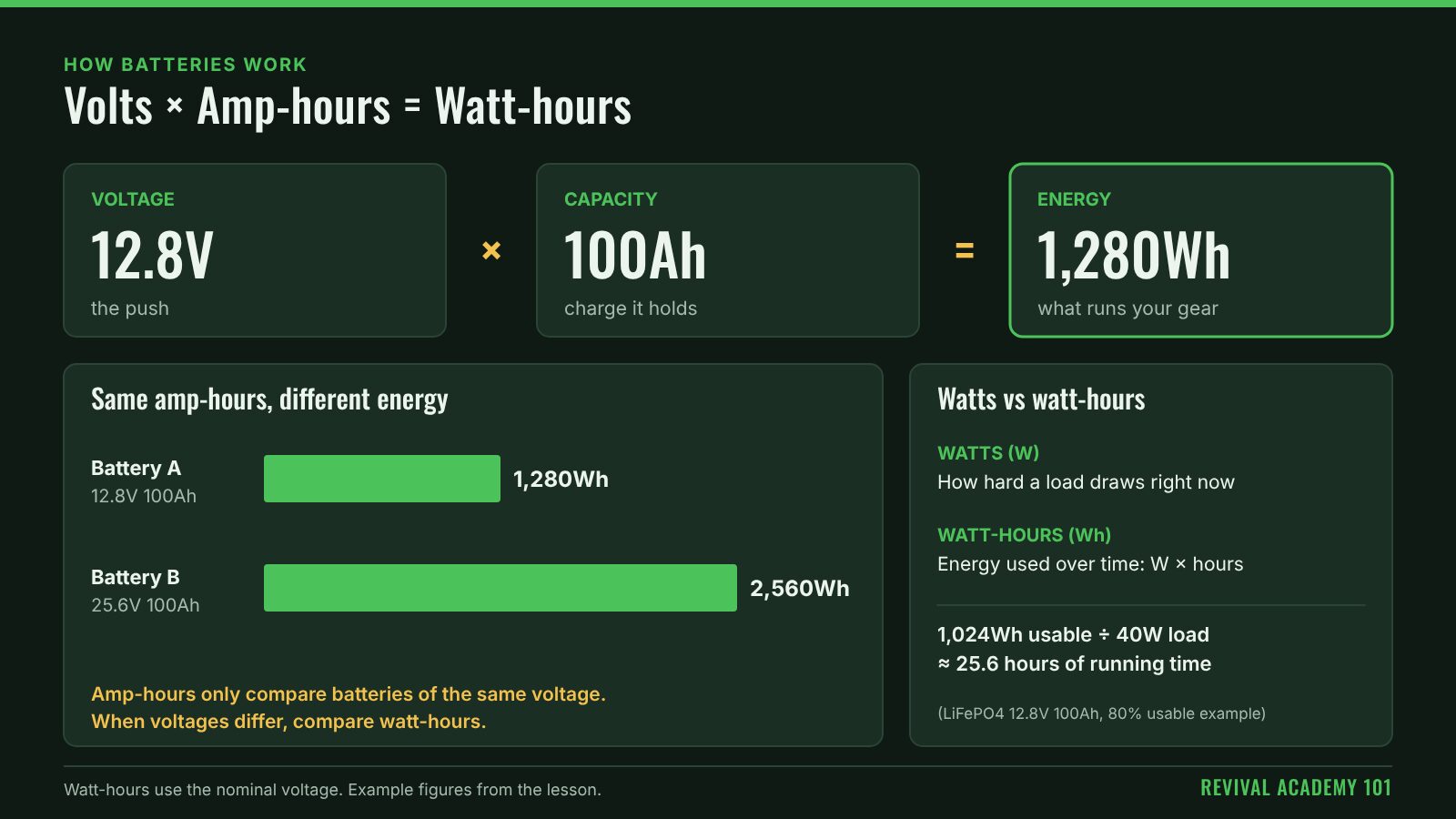
Watt-hours = nominal voltage × amp-hours
- A 12.8V 100Ah battery: 12.8 × 100 = 1,280Wh
- A 3.7V 10,000mAh power bank: 3.7 × 10 = 37Wh
- An 18V 5.0Ah tool pack: 18 × 5 = 90Wh
The mAh, Ah and Wh Converter does these sums.
5. Why amp-hours alone can mislead
Amp-hours only compare batteries of the same voltage. Two batteries can have the same Ah but very different energy.
Worked example: two batteries, both labelled 100Ah.
- Battery A: 12.8V 100Ah = 12.8 × 100 = 1,280Wh
- Battery B: 25.6V 100Ah = 25.6 × 100 = 2,560Wh
Same amp-hours, but Battery B holds twice the energy.
And the other way round:
- Battery C: 12.8V 200Ah = 2,560Wh
- Battery B: 25.6V 100Ah = 2,560Wh
Different amp-hours, same energy.
When batteries have different voltages, compare watt-hours, not amp-hours.
6. Usable capacity: not all of it is for you
A battery's rated capacity isn't always all usable.
- Lead-acid batteries (AGM, gel and flooded) last much longer if you only use part of their capacity, often around half. Using more shortens their life.
- Lithium (LiFePO4) batteries usually let you use most of their rating.
- The maker decides. The specification gives the recommended depth of discharge or a usable energy figure. Use that, not a general rule.
Worked example: two 12V 100Ah batteries.
- AGM, using about half: 12 × 100 × 0.5 = 600Wh usable
- LiFePO4, using 80% (example figure): 12.8 × 100 × 0.8 = 1,024Wh usable
Same amp-hour rating, but the lithium battery gives you about 1.7 times the usable energy in this example. The LiFePO4 vs AGM lesson goes into the differences.
7. Turning energy into running time
Once you know the usable energy, you can estimate how long something will run:
Hours ≈ usable watt-hours ÷ watts drawn
Worked example: the LiFePO4 battery above, with 1,024Wh usable, running a 40W load.
- 1,024 ÷ 40 ≈ 25.6 hours
If the load runs through an inverter, the battery supplies more than the load uses, because the inverter loses some energy. Allow for the inverter's efficiency.
8. Other things that change real capacity
- Temperature: cold reduces the energy a battery can deliver, and some batteries limit charging in the cold.
- Age: all batteries lose capacity over time and use.
- Discharge rate: drawing current fast can reduce what you get, especially from lead-acid.
- State of charge: a battery that isn't full can't give its full capacity.
9. Common beginner mistakes
- Comparing amp-hours across different voltages. Compare watt-hours.
- Assuming all of the rated capacity is usable. Check the maker's usable figure.
- Mixing up mAh and Ah, or using the max voltage instead of the nominal voltage in a watt-hour sum.
- Forgetting inverter losses when estimating running time.
- Trusting a no-name label. Counterfeit batteries often claim far more capacity than they have.
10. Safety boundaries
- Batteries store a lot of energy, and even small ones can deliver a large current into a short circuit. Keep metal tools, jewellery and loose wires away from the terminals.
- Never charge or use a battery that is swollen, leaking, hot or damaged. If one is smoking or on fire, get away and call 000.
- Use only a charger that suits the battery's chemistry and voltage.
- In Australia, work on 240V AC mains wiring must be carried out by a licensed electrician.
11. The main lesson
Voltage is the push. Amp-hours are the charge. Watt-hours are the energy, and they're the fair way to compare batteries. Then check how much of it you can actually use.
Continue learning
Revival Academy 101 shares practical tutorials to help you understand electrical systems and make informed decisions.
Explore related Bush & Bench projects:
- BENCH — Cordless Revival: cordless tool batteries and workshop equipment.
- BUSH — Wired For The Wild: vehicle, camping and 12V power.
- HOMESTEAD — Home & Workshop Solar: solar, battery storage and off-grid systems.
Disclosure: Some pages may contain affiliate links. Where applicable, purchases through these links may earn us a commission at no additional cost to you.
Technical note: This is general educational information, not a substitute for a design calculation, manufacturer instructions or applicable Australian standards.