There are only two ways to join batteries or solar panels together: in a line (series) or side by side (parallel). Series adds the voltage. Parallel adds the current, or for batteries, the amp-hours. Once you know that one rule, battery banks and solar strings make a lot more sense.
This lesson explains what each connection does, shows the maths with simple examples, and covers the limits that makers set. It is about understanding, not wiring. It does not tell you how to wire, fuse or install anything.
1. The one rule to remember
- Series: voltages add, current (or amp-hours) stays the same.
- Parallel: current (or amp-hours) adds, voltage stays the same.
- Either way, total energy adds. Two batteries hold twice the watt-hours of one, however you join them.
If you've done the Volts, Amps, Watts and Ohms lesson, think of the water hose again. Series is like stacking pumps one after another: each one adds more pressure (voltage), but the flow (current) is the same through all of them. Parallel is like running pumps side by side into a bigger pipe: the pressure stays the same, but the flow adds up.
2. What series and parallel mean
Series means joining the positive terminal of one battery or panel to the negative terminal of the next, so they form a chain. The two free ends become the bank's positive and negative.
Parallel means joining all the positives together and all the negatives together, so every battery or panel sits side by side at the same voltage.
Series-parallel means making two or more series strings, then joining those strings in parallel. It's how bigger banks and solar arrays reach the voltage and the capacity they need.
Getting polarity right matters. Joining a positive to a negative where it doesn't belong is a short circuit, and batteries can deliver enough current to melt metal, start a fire or burst the battery. Always follow the maker's diagram for your exact model.
3. Batteries in series
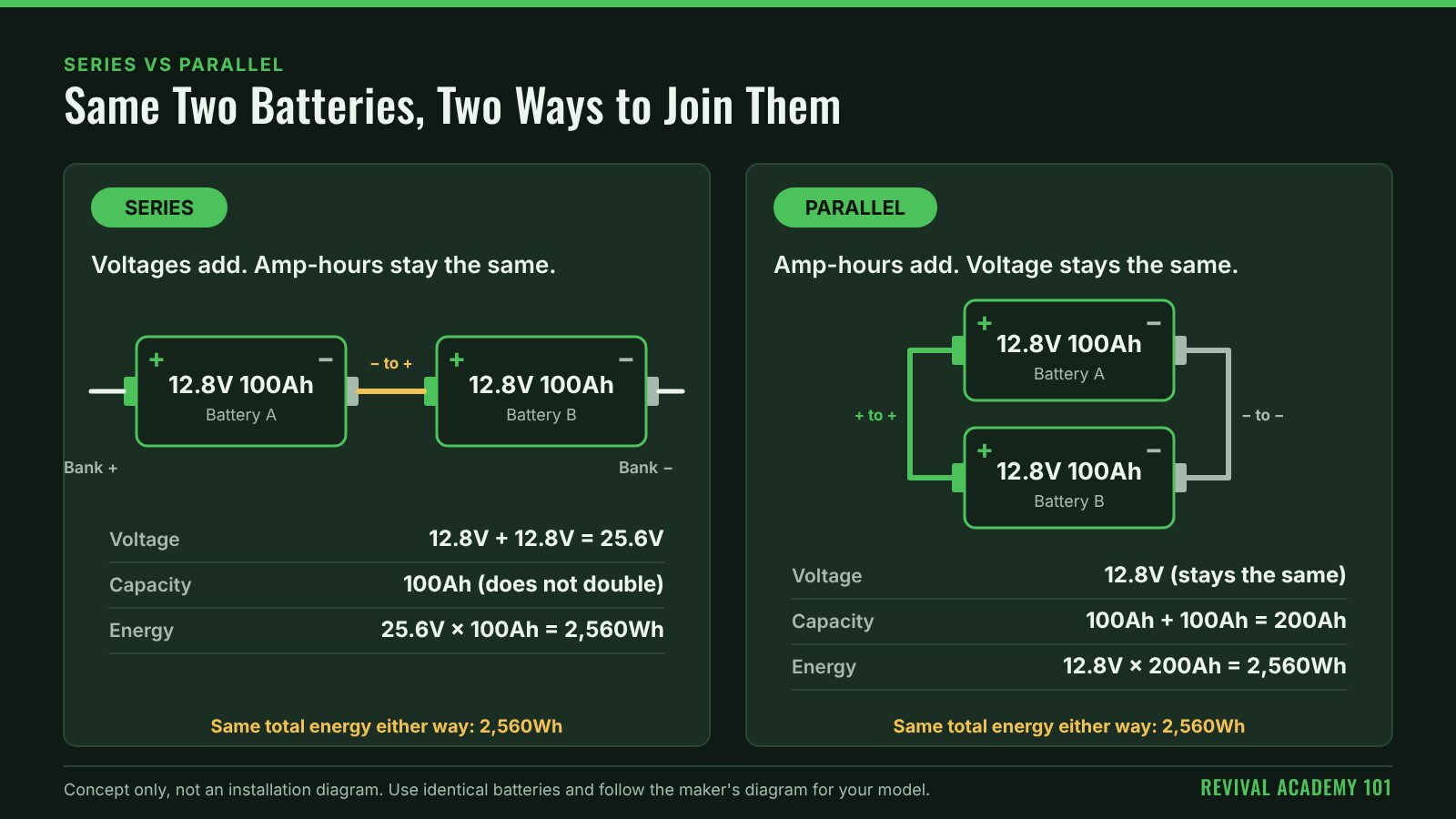
In series, voltages add and the amp-hour rating stays the same.
Worked example (example batteries, not a product recommendation): two 12.8V 100Ah lithium (LiFePO4) batteries in series.
- Voltage: 12.8V + 12.8V = 25.6V
- Capacity: 100Ah (it does not double)
- Energy: 25.6V × 100Ah = 2,560Wh
That's how two "12V" batteries make a "24V" bank.
4. Batteries in parallel
In parallel, amp-hours add and the voltage stays the same.
Worked example: the same two 12.8V 100Ah batteries in parallel.
- Voltage: 12.8V (it stays the same)
- Capacity: 100Ah + 100Ah = 200Ah
- Energy: 12.8V × 200Ah = 2,560Wh
Notice the energy is the same 2,560Wh as the series bank. Series and parallel don't create energy. They only change how it's packaged: higher voltage, or more amp-hours.
5. Series-parallel banks
Worked example: four 12.8V 100Ah batteries, set up as two series strings of two, with the strings joined in parallel (often written as 2S2P).
- Each string: 25.6V, 100Ah
- Two strings in parallel: 25.6V, 200Ah
- Energy: 25.6V × 200Ah = 5,120Wh (the same as 4 × 1,280Wh)
To work out a bank layout for your own batteries, the Battery Bank Series & Parallel Calculator at Wired For The Wild does this maths for a bank of identical batteries.
6. Why a higher voltage means less current
Power (watts) = volts × amps. So for the same power, a higher voltage needs fewer amps.
Worked example: a 1,200W load.
- At 12.8V: 1,200 ÷ 12.8 ≈ 94A
- At 25.6V: 1,200 ÷ 25.6 ≈ 47A
Doubling the voltage halves the current. That's one reason larger systems often run at 24V or 48V instead of 12V. Home & Workshop Solar's guide to choosing 12V, 24V or 48V covers that decision.
Lower current doesn't mean you can skip anything. Cables, fuses and isolators for any bank still need to suit that bank. Use your maker's instructions and a qualified installer for those choices.
7. Solar panels in series
Solar panels follow the same rule. In series, panel voltages add and the current stays about the same.
Every panel has a few figures on its label or data sheet:
- Voc (open-circuit voltage): the highest voltage the panel makes, with nothing connected.
- Vmp (voltage at maximum power): the voltage it works at when producing its rated power.
- Isc (short-circuit current): the most current it can push.
Worked example (example panel figures; take yours from the label): a panel with Voc 45V and Isc 11A.
- Two in series: Voc = 45 + 45 = 90V, current about 11A
- Three in series: Voc = 135V, current about 11A
The cold-morning catch
A panel's voltage goes up as it gets colder. The label figures are measured at 25°C. On a frosty morning, a string can make more than its label voltage.
Data sheets give this as a temperature coefficient for Voc, such as −0.30% per °C. The minus sign means voltage rises as temperature falls.
Worked example: the same 45V Voc panel, coefficient −0.30% per °C, on a 0°C morning.
- Temperature drop from 25°C: 25°C
- Voltage rise: 25 × 0.30% = 7.5%
- Cold Voc per panel: 45 × 1.075 ≈ 48.4V
- Two in series: ≈ 96.8V
- Three in series: ≈ 145.1V
- Four in series: ≈ 193.5V
Now compare that with a solar charge controller rated for 150V maximum input:
- Two panels: about 96.8V, comfortably under 150V.
- Three panels: about 145.1V, under 150V, but with very little room to spare. A colder morning could push it over.
- Four panels: about 193.5V, well over 150V. That could destroy the controller.
A controller's maximum input voltage is an absolute limit. Use the maker's own string-sizing tool if one is offered. The MPPT Controller Size Calculator at Home & Workshop Solar checks the cold-morning voltage for you.
Above 120V DC is a different world
Three of these panels in series make more than 120V DC on a cold morning. Above 120V DC, a system is no longer extra-low voltage and can give a dangerous shock. Panel wiring at that voltage must be done by a licensed electrician.
8. Solar panels in parallel
In parallel, panel currents add and the voltage stays about the same.
Worked example: two of the same panels (Voc 45V, Isc 11A) in parallel.
- Voltage: Voc about 45V (cold morning about 48.4V)
- Current: Isc 11 + 11 = 22A
Controllers also have a maximum input current. Check that the combined current suits the controller's specifications.
9. Series or parallel for solar: the trade-offs
| Series | Parallel | |
|---|---|---|
| Voltage | Adds up | Stays about the same |
| Current | Stays about the same | Adds up |
| Shade on one panel | Can drag down the whole string | Mostly affects that panel only |
| Main limit to check | Controller's maximum input voltage, on the coldest morning | Controller's maximum input current |
| Needs an MPPT controller? | Usually, once the string voltage is well above the battery voltage | Works with PWM or MPPT, depending on the panels |
Many systems use a mix of both. The right layout depends on the panels, the controller, shading and the site. Home & Workshop Solar explains the controller side in PWM vs MPPT Charge Controllers.
10. Don't mix and match
Series and parallel only work well when the parts match.
Batteries:
- Don't mix batteries of different chemistry, capacity, age, brand or model unless the maker says it's allowed.
- Don't join batteries at different states of charge. Fully charge each one first, as most makers ask.
- Some lithium batteries can't be connected in series at all. Others allow only a limited number in series or parallel. Each battery's internal battery management system (BMS) has limits, and the maker sets the rules. The LiFePO4 vs AGM lesson explains what a BMS does.
- In a mismatched series string, the weakest battery can be over-charged or over-discharged.
Solar panels:
- In series, the string current is held back by the weakest panel, so mismatched panels waste power.
- In parallel, panels with different voltages work against each other.
- If you must combine different panels, check with the panel and controller makers first.
11. Common beginner mistakes
- Thinking series doubles capacity. It doubles voltage. The amp-hours stay the same.
- Thinking parallel doubles voltage. It doubles amp-hours (or current). The voltage stays the same.
- Forgetting the cold-morning voltage. Sizing a solar string on label Voc alone can overload the controller in winter.
- Mixing old and new batteries. The older battery limits and can damage the bank.
- Joining batteries that aren't charged to the same level. Large currents can flow between them.
- Getting polarity wrong. A reversed connection can short a battery or damage equipment.
- Treating a calculator as a wiring design. Calculators give nominal figures. They don't check cables, fuses, isolators or the BMS.
12. Quick summary
- Series adds voltage. Parallel adds current or amp-hours.
- Total energy (Wh) adds either way.
- Higher voltage means less current for the same power.
- Solar panel voltage rises in the cold, so check the coldest morning against the controller's limit.
- Above 120V DC, panel wiring must be done by a licensed electrician.
- Match your batteries and panels, and follow the makers' rules for your exact models.
Before you connect anything: this lesson explains how series and parallel work. It is not a wiring guide, and it doesn't cover cable sizes, fuses, isolators or installation. Follow your battery, panel and controller makers' instructions. Have a qualified installer or licensed electrician do work you're not sure of.
Continue learning
Revival Academy 101 shares practical tutorials to help you understand electrical systems and make informed decisions.
Explore related Bush & Bench projects:
- BENCH — Cordless Revival: cordless tool batteries and workshop equipment.
- BUSH — Wired For The Wild: vehicle, camping and 12V power.
- HOMESTEAD — Home & Workshop Solar: solar, battery storage and off-grid systems.
Disclosure: Some pages may contain affiliate links. Where applicable, purchases through these links may earn us a commission at no additional cost to you.
Technical note: This is general educational information, not a substitute for a design calculation, manufacturer instructions or applicable Australian standards.