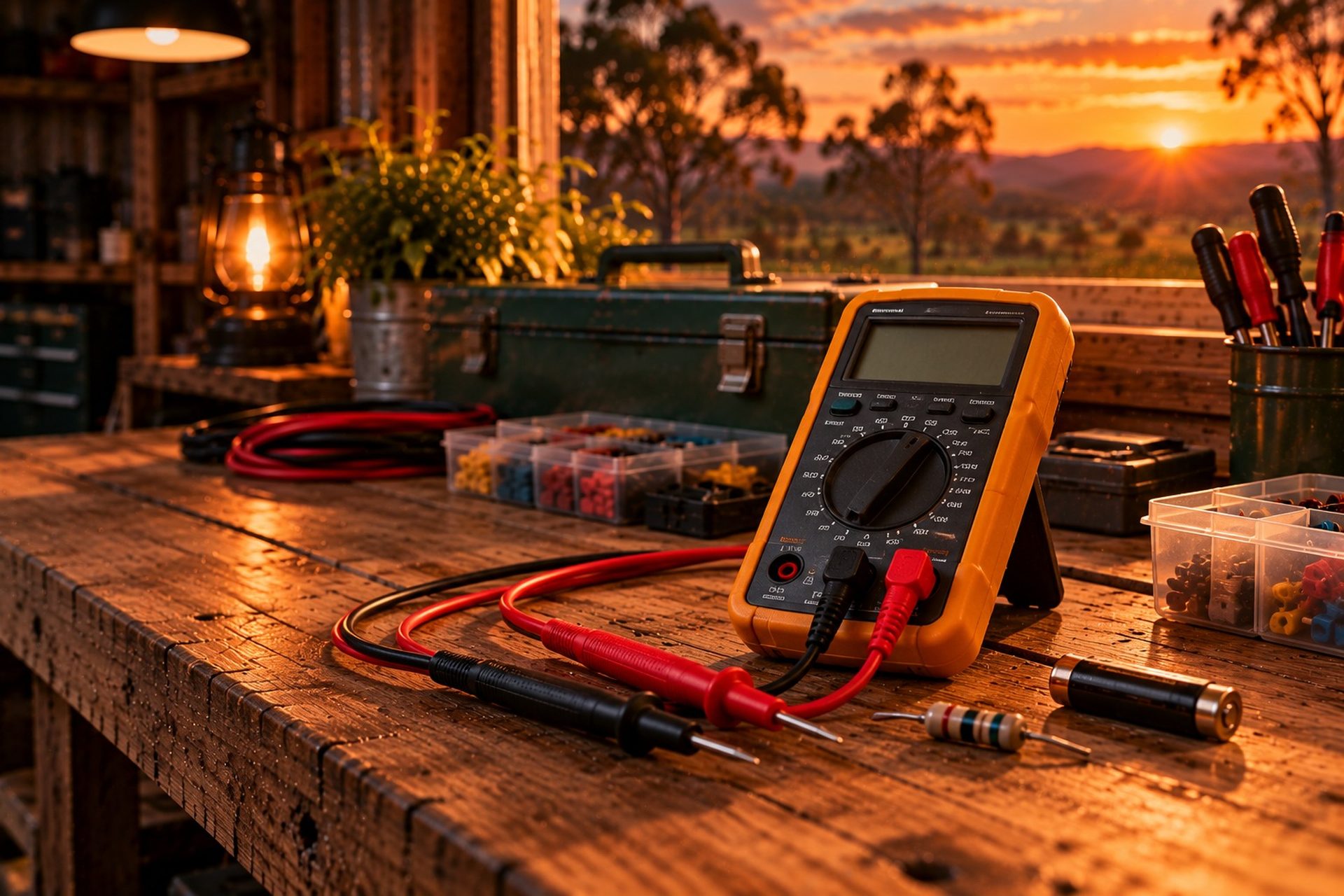
Brown, black, red, gold. Here is how to turn the stripes into ohms.
A resistor limits current. It's the part that stops an LED burning out, sets a voltage in a divider, or pulls a signal up or down.
1. Ohms
Resistance is measured in ohms (Ω). 1 kΩ is 1,000 ohms. 1 MΩ is 1,000,000 ohms.
2. Reading a 4-band resistor
Hold it with the gold or silver band on the right.
- First band: first digit.
- Second band: second digit.
- Third band: multiplier (how many zeros).
- Fourth band: tolerance.
| Colour | Digit | Multiplier |
|---|---|---|
| Black | 0 | ×1 |
| Brown | 1 | ×10 |
| Red | 2 | ×100 |
| Orange | 3 | ×1k |
| Yellow | 4 | ×10k |
| Green | 5 | ×100k |
| Blue | 6 | ×1M |
| Violet | 7 | ×10M |
| Grey | 8 | |
| White | 9 | |
| Gold | ×0.1 | |
| Silver | ×0.01 |
Brown, black, red, gold is 1, 0, ×100 = 1,000 Ω (1 kΩ) at ±5%.
3. Tolerance
Gold is ±5%, silver ±10%, brown ±1%. A 1 kΩ 5% resistor can read anywhere from 950 to 1,050 Ω and still be fine.
4. Power rating
A resistor turns power into heat. Power = current² × resistance. Pick a resistor rated at least double what it will actually dissipate. Small through-hole resistors are often 0.25W.
5. Checking one
Take it out of circuit (or lift one leg) and measure on the ohms range. Measuring it in circuit can give a lower reading because other parts are connected in parallel.
6. Quick summary
- Bands give digit, digit, multiplier, tolerance.
- Rate it for at least double the heat it makes.
- Measure out of circuit.
- Try the Resistor Colour Code Calculator.
240V AC mains can kill. In Australia, work on household mains wiring must be carried out by a licensed electrician. Low-voltage DC can still deliver very high current, so treat batteries with respect.