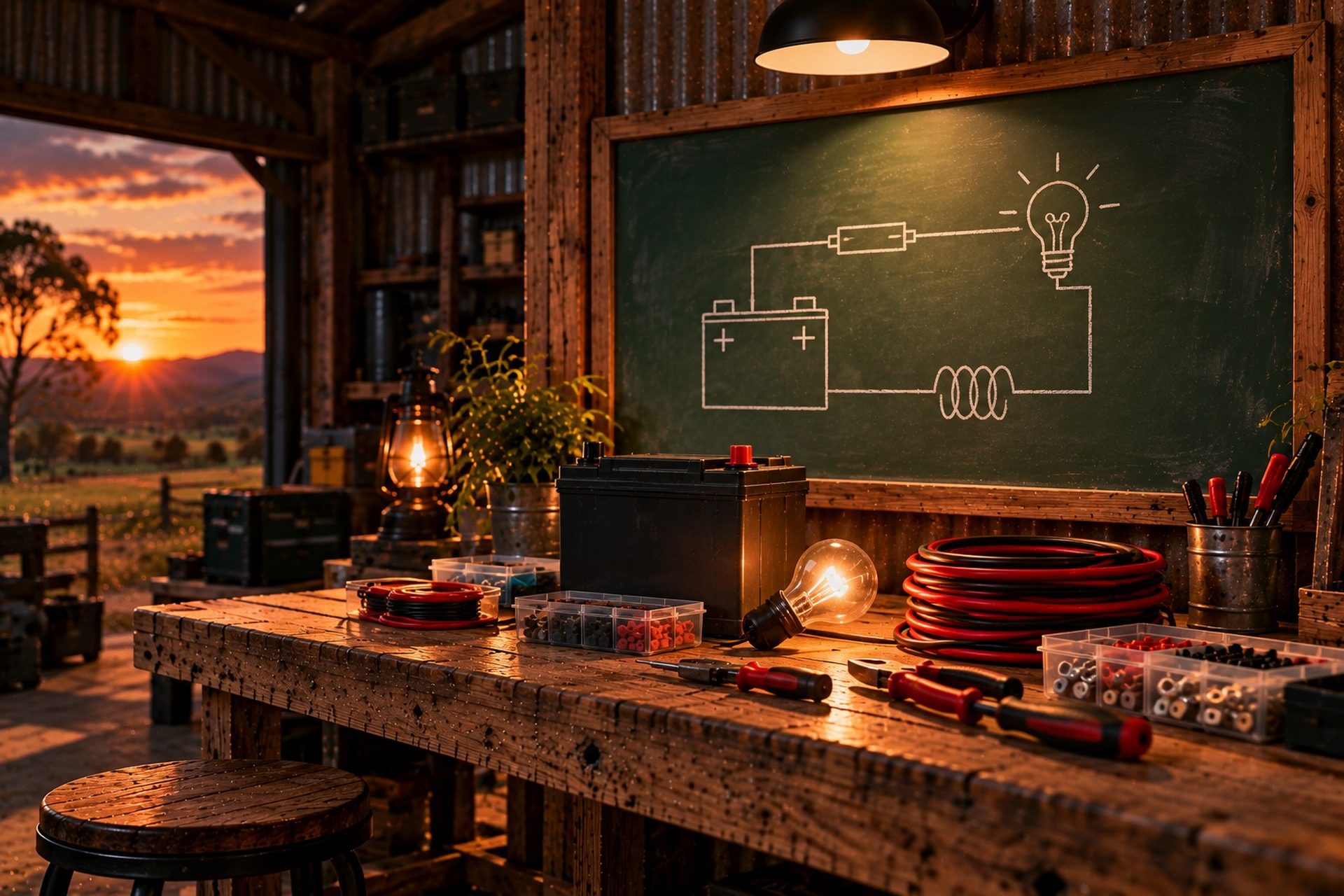
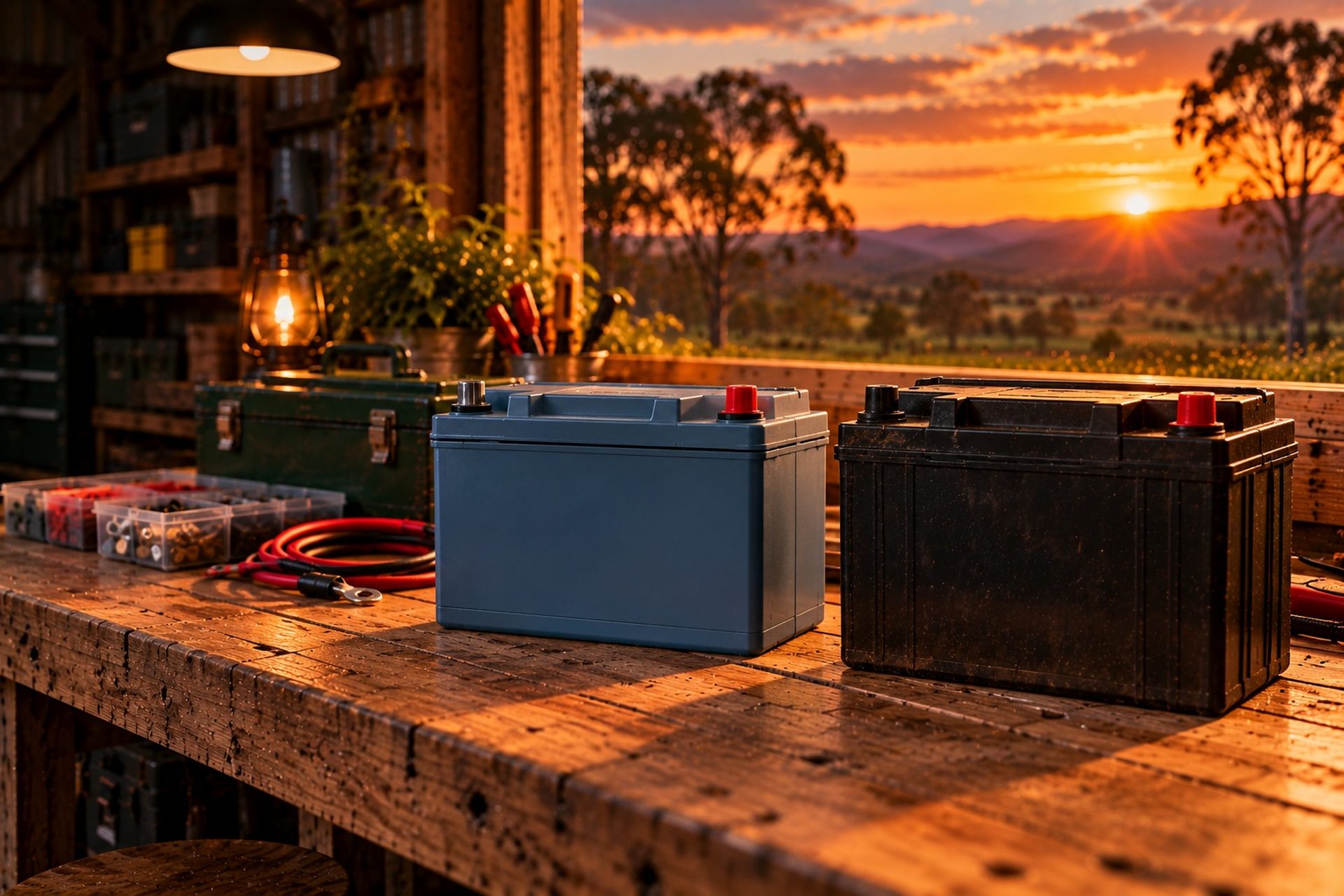
A portable power station and a DIY battery box both store energy in a battery and let you run gear away from mains power. They're built very differently, though, and the "best value" one depends on what you add to it, how you'll charge it and how comfortable you are with 12V work.
This lesson teaches you how to compare them properly, using the numbers that matter. It is about choosing, not building. It doesn't tell you how to wire, fuse or install anything.
1. What each one is
A portable power station is an all-in-one box. Inside one case you get:
- a battery (often lithium iron phosphate, LiFePO4, in newer units);
- a battery management system (BMS) that protects it;
- an inverter for 240V AC outlets;
- 12V, USB and sometimes other DC outlets;
- chargers for mains, solar and a vehicle socket.
You buy it, charge it and use it. You can't usually change what's inside.
A DIY battery box is a battery (often a 12V LiFePO4 with its own BMS) in a box that you, or someone you pay, fits out with outlets, protection, a battery monitor and whatever chargers you choose. An inverter, if you need 240V AC, is usually a separate item.
And a third thing that isn't either: a fixed home battery system is installed by a licensed electrician, connected to the switchboard, and is usually much bigger. A portable power station is not the same thing, even when it's marketed for "home backup". Section 8 explains why.
2. The numbers that matter
Ignore the marketing words and compare these figures from the manuals and spec sheets:
| Figure | What it tells you |
|---|---|
| Rated capacity (Wh) | How much energy the battery holds when new |
| Usable capacity | How much of that you can actually use. Use the maker's figure if they give one |
| Inverter continuous watts (W) | The biggest 240V AC load it can run steadily |
| Inverter surge watts (W) | The short burst it can give a motor or compressor as it starts |
| 12V outlet limit (A) | Many power stations limit the 12V socket to around 10A |
| Charging input limits (W) | How fast it can refill from mains, solar and a vehicle |
| Battery chemistry | LiFePO4 and other lithium types differ in cycle life, weight and cold-charging limits |
| Weight | Whether you can actually lift it in and out of the car |
If you need a refresher on watts and watt-hours, see Volts, Amps, Watts and Ohms Explained. For battery chemistry, see LiFePO4 vs AGM.
3. Losses: why rated watt-hours aren't runtime
Two things eat into the rated figure before your gear sees any of it.
- Usable capacity. Batteries keep some charge in reserve. Wired For The Wild's Power Station Runtime Calculator starts at 90% usable unless the maker gives a figure.
- Conversion losses. Turning battery power into 240V AC through an inverter wastes some of it as heat. The same calculator starts at 85% for the inverter and 90% for the 12V and USB outlets. An inverter also draws some power just being switched on.
The practical rule: run 12V gear from 12V outlets wherever you can. Plugging a 12V device's mains adaptor into the inverter loses energy twice.
4. Worked example: runtime
All figures here are made-up teaching examples, not real products.
A weekend camp uses:
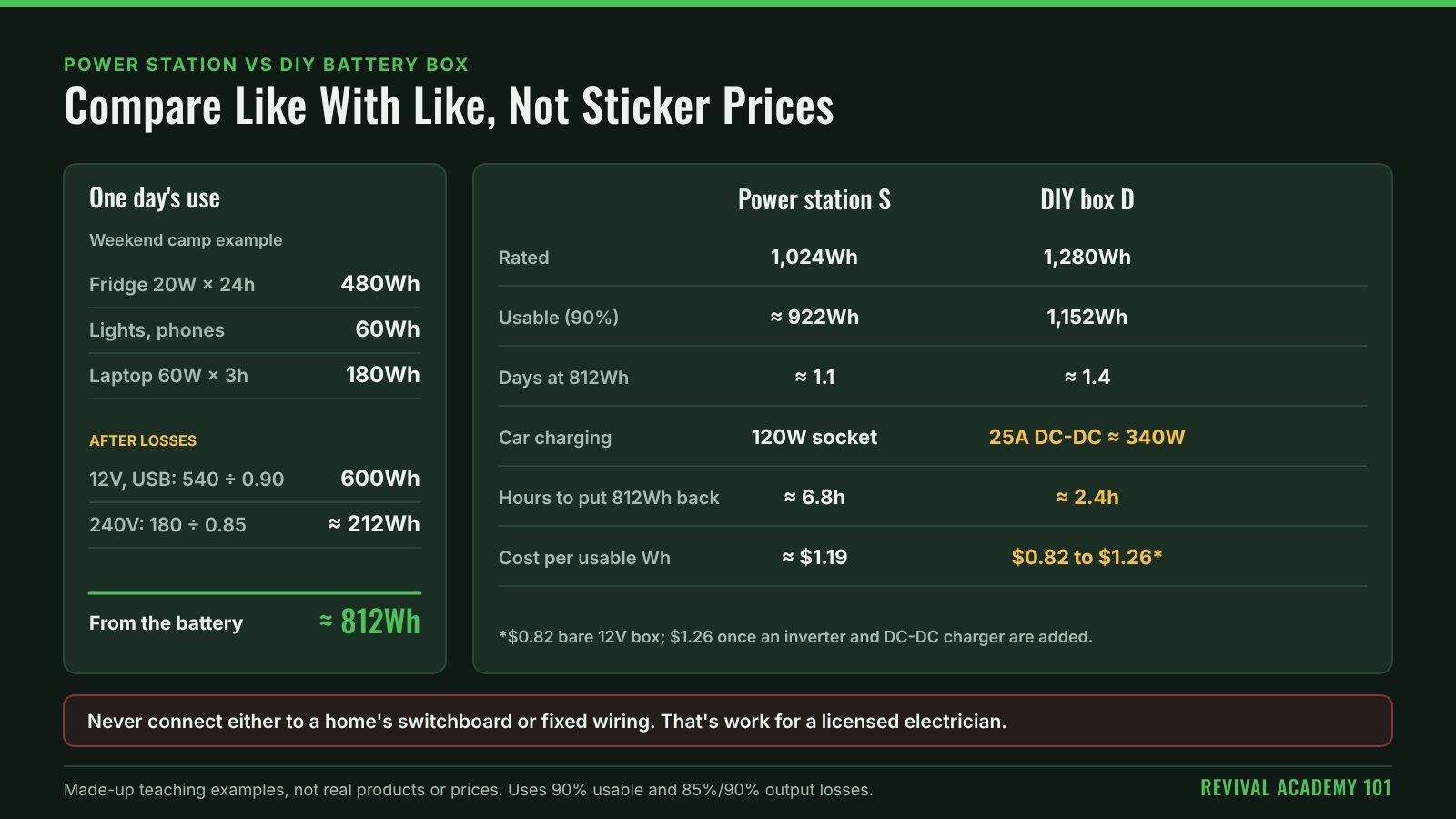
- a 12V fridge averaging 20W across the day: 20 × 24 = 480Wh;
- lights and phone charging from 12V and USB: 60Wh;
- a laptop on its 240V AC charger, 60W for 3 hours: 180Wh.
Allowing for losses with the calculator's starting figures:
- 12V and USB: (480 + 60) ÷ 0.90 = 600Wh from the battery;
- 240V AC: 180 ÷ 0.85 ≈ 212Wh from the battery;
- total: about 812Wh a day (before inverter standby draw).
| Power station S | DIY box D | |
|---|---|---|
| Rated capacity | 1,024Wh | 12.8V × 100Ah = 1,280Wh |
| Usable (90%, example) | ≈ 922Wh | 1,152Wh |
| Days at 812Wh a day | ≈ 1.1 days | ≈ 1.4 days |
Neither gets through a whole weekend without recharging. The next two sections are where the real differences show up.
5. Worked example: charging on the road
Both need to be refilled. Say one day's use, about 812Wh, has to go back in while you drive. Example figures only; charging losses and taper aren't included, so real times are longer.
| Charging method (example) | Charge power | Time to put back 812Wh | |
|---|---|---|---|
| Power station S | Vehicle 12V socket, input limited to 120W | 120W | ≈ 6.8 hours of driving |
| DIY box D | 25A DC-DC charger at about 13.6V | ≈ 340W | ≈ 2.4 hours of driving |
This is one of the biggest practical differences. Many power stations charge slowly from a car socket, while a DIY box is often built around a DC-DC charger. Some power stations offer faster vehicle charging with an extra accessory. Check the actual input limits in the manual. For sizing a DC-DC charger, see Wired For The Wild's What Size DC-DC Charger Do I Need?.
Solar works the same way. A power station's solar input limit caps what it can take. Adding panels beyond that limit doesn't charge it faster.
6. Worked example: cost per usable watt-hour
The sticker price isn't a fair comparison. Divide the price by the usable watt-hours, and include everything you need to make each option do the job.
The prices below are invented round numbers to show the method. They are not real prices or products.
| Option | What's included | Price (made up) | ÷ usable Wh | Cost per usable Wh |
|---|---|---|---|---|
| Power station S | Everything in the box | $1,100 | 922Wh | ≈ $1.19 |
| DIY box D, 12V only | Battery $550, box, outlets, monitor and protection $250, mains charger $150 | $950 | 1,152Wh | ≈ $0.82 |
| DIY box D plus a 240V AC inverter | As above, plus inverter $200 | $1,150 | 1,152Wh | ≈ $1.00 |
| DIY box D plus inverter and DC-DC charger | As above, plus DC-DC charger $300 | $1,450 | 1,152Wh | ≈ $1.26 |
What the example shows:
- A bare DIY box can be much cheaper per watt-hour.
- Once you add the extras a power station already has, the gap can shrink or even reverse.
- But the extras aren't equal either. In this example, the DC-DC charger refills nearly three times faster than the power station's car socket.
- The DIY figures don't include your tools or your time, and they assume you build it right the first time.
So the honest answer to "which is cheaper?" is: compare like with like, for the features you'll actually use.
7. Skills, safety and support
Power station
- Ready to use. No wiring.
- If one part fails, the whole unit usually goes back for repair.
- Capacity is fixed unless the maker sells expansion batteries for it.
- Buy one sold for the Australian market, and look for the Regulatory Compliance Mark (RCM) on the unit or its charger.
DIY battery box
- You choose every part, and you can repair or upgrade one part at a time.
- It needs the right tools, basic electrical skills and time.
- Every DIY box needs correctly chosen protection, cables and connections. A 12V battery can deliver enough current into a short circuit to melt metal and start a fire. Choosing fuses, cable sizes and isolators depends on the battery, the loads and the makers' instructions. This lesson doesn't size them. Follow the makers' instructions, and get qualified advice if you're not sure.
- Each part has its own warranty, and you're responsible for how they work together.
8. A power station is not a home backup system
Power stations are often marketed for "home backup". They can be handy in a blackout for a fridge, lights, a modem and phone charging, plugged in directly with their own leads. But they aren't the same as a fixed home battery:
- Size. Home & Workshop Solar's workshop example uses about 2,250Wh a day. The 1,024Wh power station in this lesson, at about 922Wh usable, would cover well under half a day of that.
- Connection. A portable power station must never be connected to a home's switchboard or fixed wiring, or "back-fed" through a power point. In Australia, any connection to fixed wiring must be done by a licensed electrician with suitable equipment.
- Switching. A fixed system with backup can switch over automatically. A power station needs you to move the plugs.
For the home side of this question, see Home & Workshop Solar's guide to home batteries and power stations.
9. Choosing: a quick guide
| If you… | Lean towards | Why |
|---|---|---|
| want it to just work, today | Power station | Nothing to build or wire |
| need 240V AC outlets often (laptops, small appliances) | Power station, or DIY plus an inverter | Built-in inverter vs a separate one |
| mostly run 12V gear (fridge, lights) | DIY box | Lower cost per usable Wh for 12V-only use |
| charge mainly while driving | DIY box with a DC-DC charger | Faster vehicle charging |
| want to repair or upgrade parts | DIY box | Parts can be swapped one at a time |
| move it between car, camp and home a lot | Power station | One tidy unit (check the weight) |
| want whole-of-house backup | Neither: a fixed system | Talk to a licensed electrician |
10. Common beginner mistakes
- Comparing sticker prices instead of cost per usable watt-hour.
- Treating rated watt-hours as runtime and forgetting losses.
- Running 12V gear through the inverter instead of the 12V outlets.
- Forgetting the 12V outlet limit on a power station.
- Buying more solar panels than the power station's solar input can use.
- Assuming a portable power station can back up a whole house.
- Building a DIY box without proper protection because "it's only 12V".
11. Safety boundaries
- 12V batteries can deliver very high current. A short across the terminals can cause burns, fire or a battery explosion.
- Never connect a portable power station or DIY box to a home's switchboard or fixed wiring, or back-feed it through a power point. Work on household mains wiring must be done by a licensed electrician.
- Use and charge power stations and battery boxes as the makers instruct, on a hard surface, with ventilation, away from anything flammable.
- If a battery is swollen, hot, damaged or smells odd, stop using it.
12. The main lesson
Compare usable watt-hours, not rated ones. Count the losses. Price both options with the features you'll actually use. Look hard at how each one recharges. A power station buys convenience; a DIY box buys flexibility and needs skill. Neither is a fixed home backup system.
Continue learning
Revival Academy 101 shares practical tutorials to help you understand electrical systems and make informed decisions.
Explore related Bush & Bench projects:
- BENCH — Cordless Revival: cordless tool batteries and workshop equipment.
- BUSH — Wired For The Wild: vehicle, camping and 12V power.
- HOMESTEAD — Home & Workshop Solar: solar, battery storage and off-grid systems.
Disclosure: Some pages may contain affiliate links. Where applicable, purchases through these links may earn us a commission at no additional cost to you.
Technical note: This is general educational information, not a substitute for a design calculation, manufacturer instructions or applicable Australian standards.