Lithium batteries run almost everything now: phones, cordless tools, e-bikes, camping setups and home solar. They're safe when they're built well and used within their limits. Problems usually start when a battery is damaged, charged the wrong way, or pushed outside the conditions it was designed for.
This lesson explains the main lithium chemistries, what the battery management system (BMS) does, and the charging habits that keep you safe.
1. "Lithium" isn't one thing
"Lithium battery" covers several chemistries. They behave differently, so the right charging and safety advice depends on which one you have.
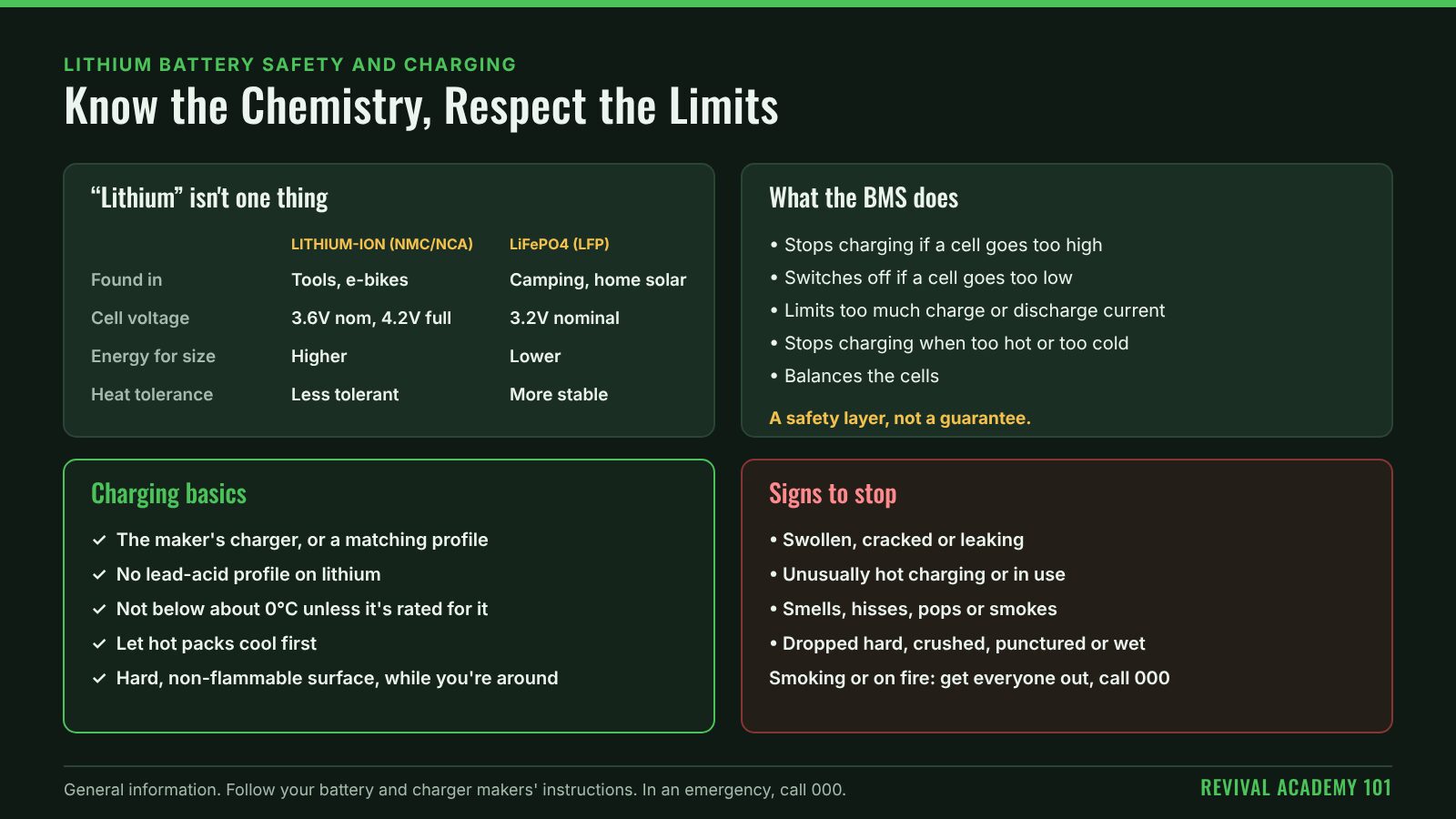
| Lithium-ion (often NMC or NCA) | Lithium iron phosphate (LiFePO4 or LFP) | |
|---|---|---|
| Where you'll find it | Phones, laptops, cordless tool packs, most e-bikes and e-scooters | Many 12V camping and caravan batteries, many home solar batteries |
| Cell voltage | About 3.6V nominal, about 4.2V full | About 3.2V nominal |
| Energy for its size | Higher | Lower |
| Heat tolerance | Less tolerant if damaged or overcharged | Generally more stable, but not risk-free |
The battery's label or data sheet tells you which chemistry it is. If it doesn't, check the maker's specification. Keep advice chemistry-specific. A rule that's right for one type can be wrong for another.
2. Why lithium needs care
Lithium cells store a lot of energy in a small space. A healthy cell keeps that energy under control. A cell that's overcharged, over-discharged, overheated, charged in the cold or physically damaged can fail. In the worst case it heats itself up, vents flammable gas and catches fire. This is called thermal runaway, and it is hard to stop once it starts.
Most lithium battery fires start with one of these:
- physical damage, such as a drop, crush or puncture
- the wrong charger, or a damaged or counterfeit one
- charging outside the safe temperature range
- cheap or counterfeit batteries with poor or missing protection
- home modifications, such as rebuilt packs or bypassed protection
3. What the BMS does
Most lithium batteries contain a battery management system (BMS). Depending on its design, it may:
- Stop charging if any cell's voltage goes too high.
- Switch the battery off if any cell's voltage goes too low.
- Limit or cut off too much charge or discharge current.
- Stop charging when the battery is too hot or too cold.
- Balance the cells so they stay at similar charge levels.
In some cordless tool systems, part of this protection is in the tool or the charger instead of the pack.
A BMS is a safety layer, not a guarantee. It can't fix a damaged cell, and it can't protect against everything. A battery with a failed or bypassed BMS can be dangerous. The LiFePO4 vs AGM lesson has more on what a BMS does.
4. Charging basics
Use the right charger.
- For tool packs, e-bikes and scooters, use the maker's charger, or one the maker approves.
- For 12V and solar lithium batteries, the mains charger, DC-DC charger and solar controller all need a charge profile that matches the battery maker's requirements.
- Don't use a lead-acid profile on a lithium battery. Some lead-acid modes, such as equalise or desulphation, deliberately push the voltage higher. That's wrong for lithium.
Watch the temperature.
- Many lithium batteries must not be charged below about 0°C unless they have low-temperature protection or built-in heating. Check the specification.
- Don't charge a pack that's hot from heavy use. Let it cool first.
- Don't charge in direct sun or in a hot vehicle.
Charge somewhere sensible.
- Charge on a hard, non-flammable surface, not on carpet, a bed or a couch.
- Keep the area clear of anything that burns.
- Avoid charging overnight or while you're out, especially e-bikes, scooters and tool packs.
- Don't charge e-bikes or scooters in a hallway or near your way out.
- Unplug the charger when charging is finished, unless the maker says otherwise.
5. Safe operating limits
Every lithium battery has limits set by its maker. The data sheet or manual lists them:
- Voltage: the charge voltage and the lowest safe voltage.
- Current: the maximum continuous and short-term charge and discharge current.
- Temperature: separate ranges for charging, discharging and storage.
Staying inside these limits is the single biggest safety habit. If you can't find the limits for a battery, treat that as a warning about the battery.
6. Signs to stop
Stop using and charging a lithium battery straight away if it:
- is swollen, cracked or leaking
- gets unusually hot when charging or in use
- smells sweet or chemical, hisses, pops or smokes
- has been dropped hard, crushed, punctured or got wet
Move it outside, away from anything flammable, if you can do that safely. If it's smoking or on fire, get everyone out and call 000.
7. Don't open or rebuild packs without the expertise
Opening a lithium pack, replacing cells or bypassing the BMS needs proper knowledge, tools and safety precautions. A mistake can short a cell, damage the protection or leave hidden faults that cause a fire later. Unless you have that expertise, don't do it. Buy a genuine replacement or use a reputable repairer.
8. Storage and disposal
- Store lithium batteries somewhere cool and dry, partly charged for long storage if the maker recommends it, and away from exits and anything flammable.
- Never put a lithium battery in household rubbish or recycling. Take it to a battery drop-off point. Damaged batteries may need special handling, so ask your local council.
Cordless Revival's Lithium Battery Storage and Disposal guide covers this in detail.
9. Common beginner mistakes
- Treating all lithium batteries the same. LiFePO4 and lithium-ion differ.
- Using any charger that fits. The charger has to suit the chemistry and the maker's requirements.
- Charging in the cold without checking the battery's low-temperature limit.
- Charging straight after heavy use while the pack is hot.
- Trusting cheap no-name batteries or chargers with unknown protection.
- Thinking the BMS makes anything safe.
- Keeping a damaged battery in use because it still works.
10. Safety boundaries
- This lesson is general information. Follow your battery and charger makers' instructions.
- Don't open, rebuild or modify lithium packs without the right expertise.
- Large battery banks and anything connected to 240V AC or a home solar system need a qualified installer and, where required, a licensed electrician.
- In an emergency, call 000.
11. The main lesson
Know your chemistry. Use the right charger and profile. Charge within the temperature limits, on a safe surface, while you're around. Stop at the first sign of damage.
Continue learning
Revival Academy 101 shares practical tutorials to help you understand electrical systems and make informed decisions.
Explore related Bush & Bench projects:
- BENCH — Cordless Revival: cordless tool batteries and workshop equipment.
- BUSH — Wired For The Wild: vehicle, camping and 12V power.
- HOMESTEAD — Home & Workshop Solar: solar, battery storage and off-grid systems.
Disclosure: Some pages may contain affiliate links. Where applicable, purchases through these links may earn us a commission at no additional cost to you.
Technical note: This is general educational information, not a substitute for a design calculation, manufacturer instructions or applicable Australian standards.