A small switch on the dash can run a big light bar. The relay is how.
A relay is a switch worked by an electromagnet. A small current through its coil pulls a contact closed, and that contact can carry a much bigger current. It lets a small dash switch control a big load without running heavy cable to the dash.
1. The pins on a standard automotive relay
| Pin | Job |
|---|---|
| 85 | Coil, usually to earth |
| 86 | Coil, switched positive from your switch |
| 30 | Common, fused feed from the battery |
| 87 | Normally open: connects to 30 when the coil is on |
| 87a | Normally closed: connects to 30 when the coil is off (5-pin relays only) |
2. How it works
- You flip the switch. A small current (often around 0.15A) flows through the coil between 86 and 85.
- The coil becomes a magnet and pulls the contact over.
- Pin 30 connects to 87, and the load gets full current.
- Switch off, the spring returns the contact, and the load stops.
3. Fuse both circuits
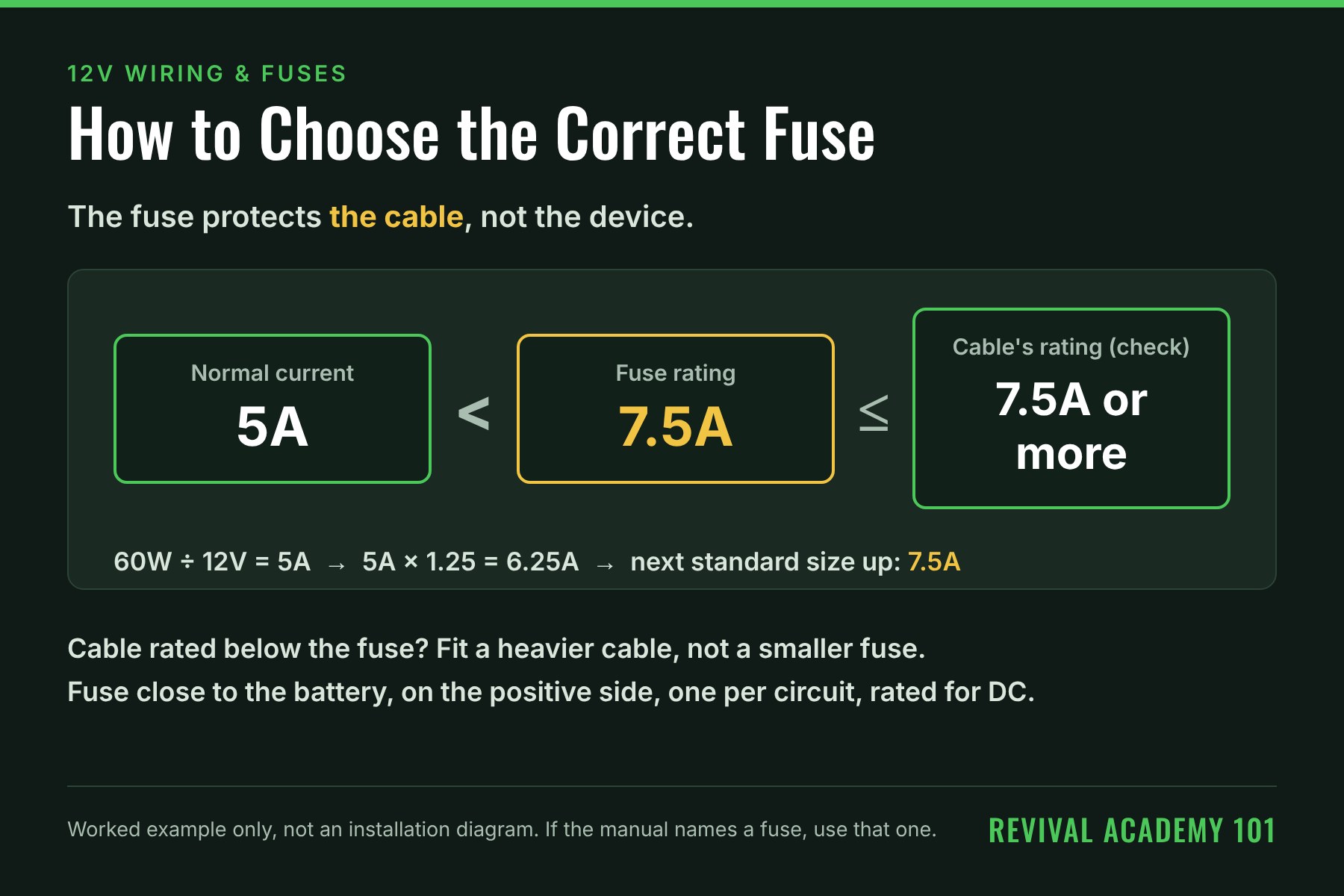
The heavy feed to pin 30 needs a fuse sized for the load cable, close to the battery. The switch circuit to 86 needs its own small fuse too.
4. Coil diodes
When the coil switches off it throws a voltage spike. Some relays have a diode or resistor built in to soak it up. A relay with a diode only works one way round, so check the diagram on the case.
5. Common mistakes
- Using the wrong relay rating. Check the contact current rating on the case.
- Mixing up 87 and 87a, so the load is on when it should be off.
- No earth on pin 85.
- Feeding 30 without a fuse.
6. Quick summary
- Small coil current switches a big load.
- 85/86 are the coil. 30 is the feed. 87 is the switched output.
- Fuse both the feed and the switch circuit.
240V AC mains can kill. In Australia, work on household mains wiring must be carried out by a licensed electrician. Low-voltage DC can still deliver very high current, so treat batteries with respect.