Putting a multimeter across a battery is the first test most people do, and it's a good one. But a voltage reading only tells you one thing: the voltage at that moment. It doesn't tell you how much energy is left, how healthy the battery is, or whether it can deliver current when you need it.
This lesson explains what a voltage reading can tell you, what it can't, and how to get more out of it. If you haven't used a meter before, start with How to Use a Multimeter Safely.
1. What a voltage reading tells you
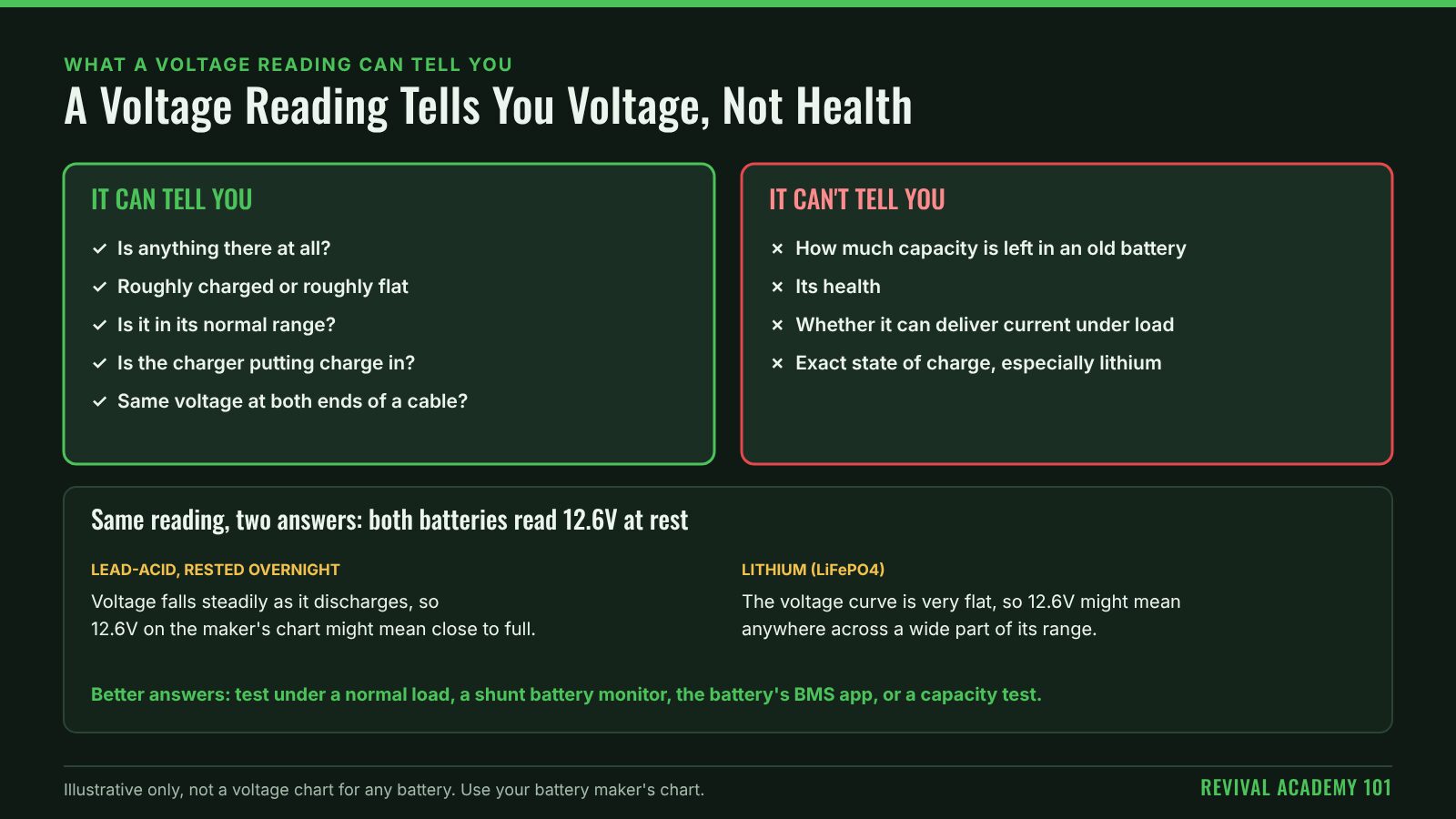
A voltage reading is useful for:
- Is there anything there at all? A reading of zero, or very close to it, on a battery that should be charged tells you something is wrong, or a protection board has switched the battery off.
- Is it roughly charged or roughly flat? For many batteries, the resting voltage gives a rough idea of state of charge, when you compare it with the maker's chart.
- Is it in its normal range? A reading far above or below the maker's normal range is a warning sign.
- Is the charger doing something? Voltage rising while on charge shows charge is going in.
- Is the voltage the same at both ends of a cable? Comparing readings is the basis of fault finding. See Find a 12V Fault Step by Step.
2. What a voltage reading can't tell you
- Capacity. An old battery and a new one can show the same voltage, but the old one may hold a fraction of the energy.
- Health. A battery with a failing cell or high internal resistance can read normal at rest.
- Whether it can deliver current. A battery can show a good voltage with nothing connected, then collapse as soon as a load is switched on.
- Exact state of charge. Especially for lithium batteries, as explained below.
One reading is not a diagnosis. Don't decide a battery is good or bad from a single voltage reading.
3. Resting voltage and surface charge
Straight after charging, a battery's voltage reads higher than it really is. This is often called surface charge. Straight after a heavy load, it reads lower, then creeps back up.
For a fairer reading, let the battery rest with no charging and no load before you measure. How long it needs depends on the chemistry and the maker. Lead-acid batteries usually need longer to settle than lithium ones. The maker's manual may give a rest time.
4. Chemistry changes everything
The same voltage means different things for different batteries.
- Lead-acid (AGM, gel and flooded): the resting voltage drops fairly steadily as the battery discharges. So once it has rested, voltage gives a reasonable rough guide to state of charge, using the maker's chart.
- Lithium (LiFePO4): the voltage stays very flat across most of the charge range, then drops quickly near empty. A small change in voltage can mean a big change in charge. Voltage alone is a poor guide to how much is left.
- Lithium-ion tool packs: most cordless packs show their charge with the pack's fuel gauge. Reading the voltage at the terminals may not work at all, because many packs only switch their output on when connected to a tool or charger.
The LiFePO4 vs AGM lesson explains the two chemistries in more detail.
Always use the voltage chart from the battery's own maker. General charts found online can be wrong for your battery.
5. Why load matters
A battery is like a water tank with a narrow outlet pipe. With the tap closed, the pressure gauge reads full. Open the tap wide, and if the outlet is blocked, the pressure at the tap drops away.
That's what happens with a weak battery or a poor connection. With no load, the voltage looks fine. Under load, current has to flow through the battery's internal resistance and every connection, and the voltage drops.
So the most useful voltage reading is often the one taken while the battery is working:
- Measure the resting voltage.
- Switch on a normal load, such as lights or a fridge, and measure again.
- A small dip is normal. A big drop, or a voltage that keeps falling quickly, points to a weak battery or a poor connection.
How much dip is "normal" depends on the battery, the load and the wiring. Compare it with the same battery when it was working well, and with the maker's information.
6. Better ways to know what's going on
- A battery monitor with a shunt counts the current going in and out, so it tracks state of charge far better than voltage alone, especially for lithium. It needs setting up and resetting to full now and then, as its manual says.
- The battery's own app or display. Many lithium batteries report state of charge, cell voltages and temperature from their BMS.
- A capacity test measures how much energy the battery really delivers from full to empty under a steady load. It's the real answer to "how good is this battery?". Use a tester and method the battery maker supports.
- A battery tester suited to the chemistry. Some testers designed for car starting batteries aren't suitable for deep-cycle or lithium batteries. Check the tester's manual.
7. Worked example: the same reading, two answers
Two 12V batteries both read 12.6V at rest.
- Battery A is a lead-acid battery that has rested overnight. Comparing 12.6V with the maker's chart might show it's close to full.
- Battery B is a lithium (LiFePO4) battery. Because the voltage is so flat, 12.6V might mean it's anywhere across a wide part of its range. The maker's chart, the BMS app or a battery monitor gives a much better answer.
Same reading, very different meaning. (This example is illustrative. It isn't a voltage chart for any battery. Use your maker's figures.)
Now switch on a 10A load. Battery A drops to 12.4V and holds steady. If it fell to 11.5V and kept dropping, that would point to a weak battery or a poor connection, even though it read 12.6V at rest. (Illustrative figures only.)
8. Common beginner mistakes
- Measuring straight off the charger and thinking the battery is fuller than it is.
- Deciding a battery is fine because it reads 12.6V with nothing connected.
- Using a lead-acid voltage chart on a lithium battery.
- Thinking a tool pack is dead because the terminals read zero, when the pack is just waiting for a tool or charger.
- Testing once and deciding. A pattern of readings over time tells you much more.
- Ignoring connections. A low reading at the load can be a cable or terminal problem, not the battery.
9. Safety boundaries
- Keep probes away from touching both terminals or any bare metal at once. Batteries can deliver very high current into a short.
- Never test or charge a battery that is swollen, leaking, hot or damaged. Move away from it, and if it's smoking or on fire, call 000.
- Don't open battery cases or lithium packs to test cells. That's beyond this lesson.
- In Australia, work on 240V AC mains wiring must be carried out by a licensed electrician.
10. The main lesson
A voltage reading tells you the voltage, not the health. Let the battery rest, know the chemistry, use the maker's chart, test under load, and use a monitor or capacity test when you need the real answer.
Continue learning
Revival Academy 101 shares practical tutorials to help you understand electrical systems and make informed decisions.
Explore related Bush & Bench projects:
- BENCH — Cordless Revival: cordless tool batteries and workshop equipment.
- BUSH — Wired For The Wild: vehicle, camping and 12V power.
- HOMESTEAD — Home & Workshop Solar: solar, battery storage and off-grid systems.
Disclosure: Some pages may contain affiliate links. Where applicable, purchases through these links may earn us a commission at no additional cost to you.
Technical note: This is general educational information, not a substitute for a design calculation, manufacturer instructions or applicable Australian standards.